
The single largest single-property impact of the White Lotus search wave on Bangkok hotel bookings was not on the Four Seasons (the show’s lobby has been quietly committed weekends), and not on the Anantara Bophut (likewise), but on the Mandarin Oriental Bangkok.
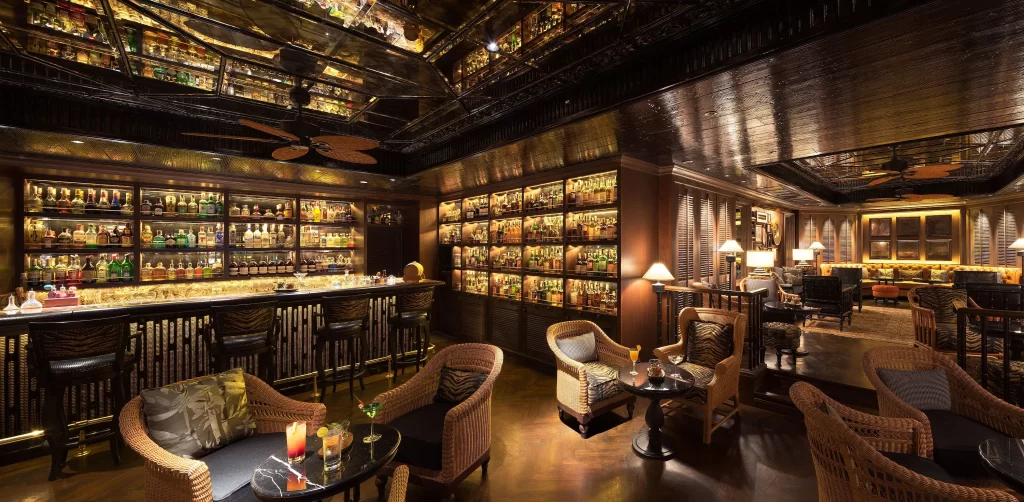
The Bamboo Bar scenes — the cocktails-with-the-mother sequence in particular — drove a sustained spike in searches and bookings for the Mandarin’s bar over the spring of 2025. The hotel itself, which has carried Bangkok’s most-recognised lobby for the better part of seventy years, saw the secondary effect: guests booking the hotel specifically for the bar.
We are not advisors who recommend against the Mandarin. The Mandarin is, by most operational measures, one of the best-run hotels in the world. The Bamboo Bar is, by most cocktail measures, one of the best in Asia. The pilgrimage is legitimate.
This piece is for the senior advisor whose Bangkok-shaped brief is wider than the pilgrimage.
The Mandarin’s actual position in Bangkok 2026
A few unromantic facts to clear the ground.
The Mandarin Oriental Bangkok was built in 1876 as the Oriental Hotel. The current building stack — the River Wing, the Garden Wing, the original Authors’ Wing — represents three generations of expansion. The property carries the most-decorated history of any luxury hotel in Southeast Asia: Conrad, Maugham, Coward, Greene, Vidal, Le Carré. The Bamboo Bar opened in 1953. The Riverside dining room was established in the 1960s.
The Mandarin is, in 2026, still the gold-standard property for the Bangkok-river view, the canonical Asian luxury-hotel experience, and the guest who measures a Bangkok stay against the hotel’s seven-decade reference frame. Service is exceptional. The river-facing rooms are exceptional.
The Mandarin is also, in 2026, the most-photographed lobby in Bangkok, the most-quoted bar in Bangkok, and now, post-show, the hotel that arrives at the booking decision with the most expectation baked in. For the right client, the expectation is the product. For the wrong client, the expectation is the friction.
The wrong client, in our experience, is the senior advisor’s client who has done Asia at this register before and is asking which Bangkok hotel they have not yet stayed at.
The Siam, properly introduced
For that client — and for the advisor whose Bangkok brief is now in its third or fourth iteration with the same guest — our standing placement is The Siam.
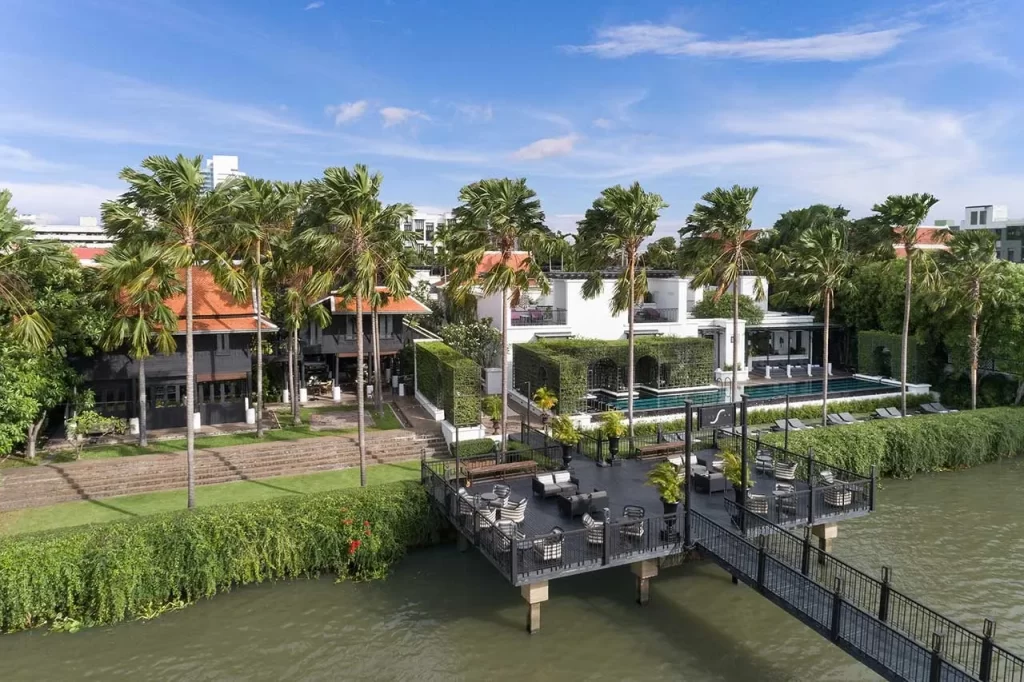
The Siam sits on the Chao Phraya river north of the main hotel cluster, in historic Dusit, at the base of the Krung Thon Bridge. Bill Bensley designed it. Krissada Sukosol Clapp built it on three acres of his family’s land. Thirty-nine suites and villas — the first private pool villas in Bangkok — hold roughly twenty-five thousand of the Sukosol family’s antiques between them.
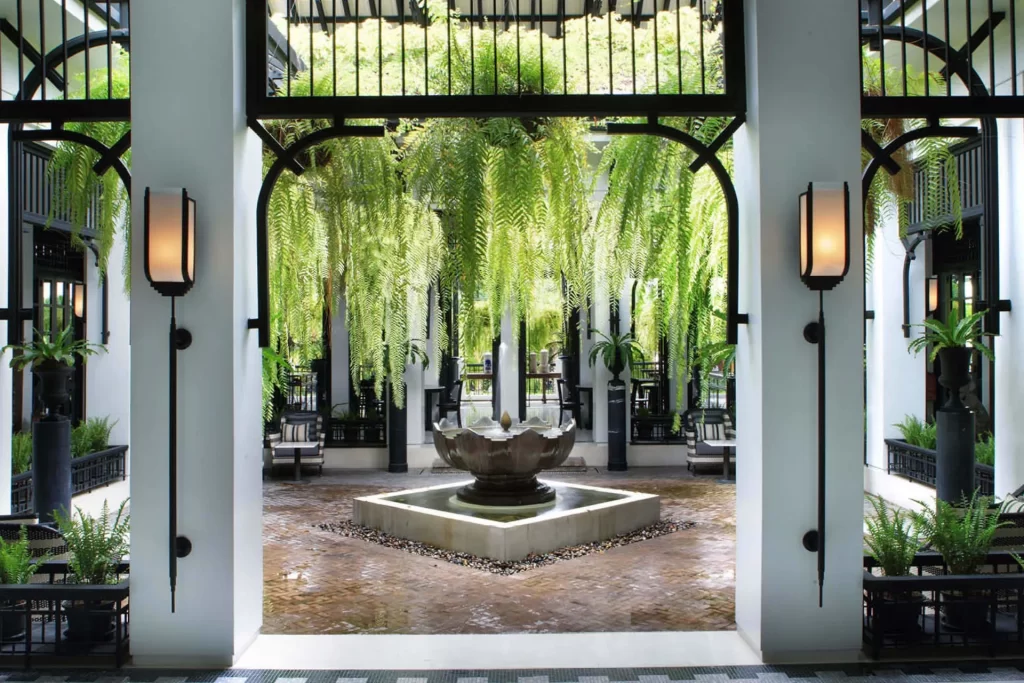
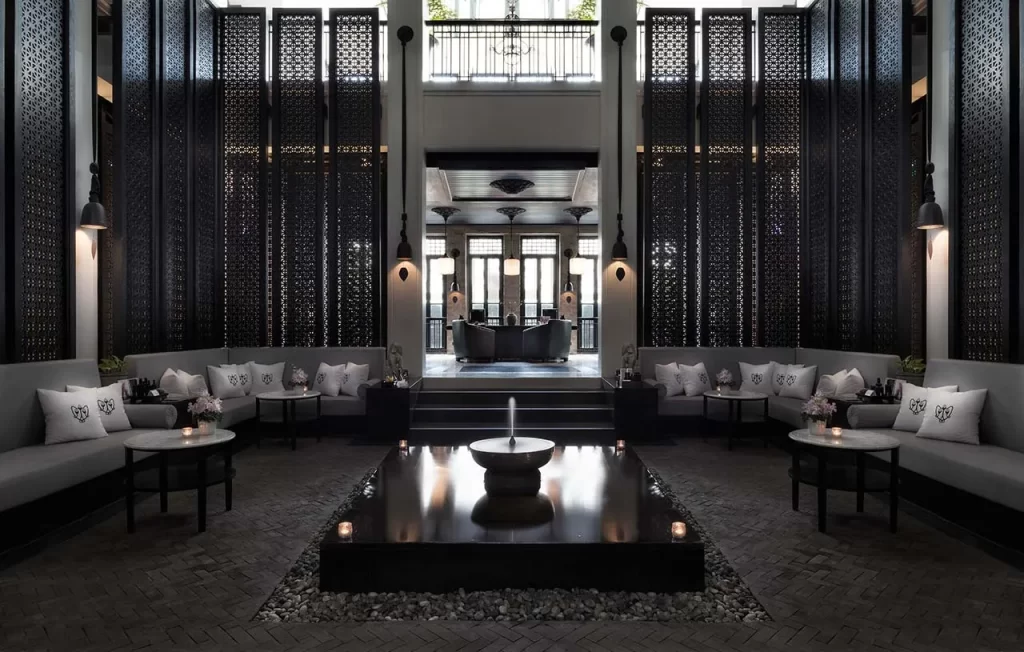
The architectural register is Art Deco crossed with traditional Thai and colonial vintage. The central atrium is a soaring black-and-white space anchored by palms and a water feature; the courtyards and verandas around it are quieter and more residential. The Pool Villa Courtyards — the property’s apex accommodation — are standalone houses with private plunge pools, lush courtyard gardens, and roof terraces. The hotel reads more as a private estate than as a commercial property, which is the design intent.
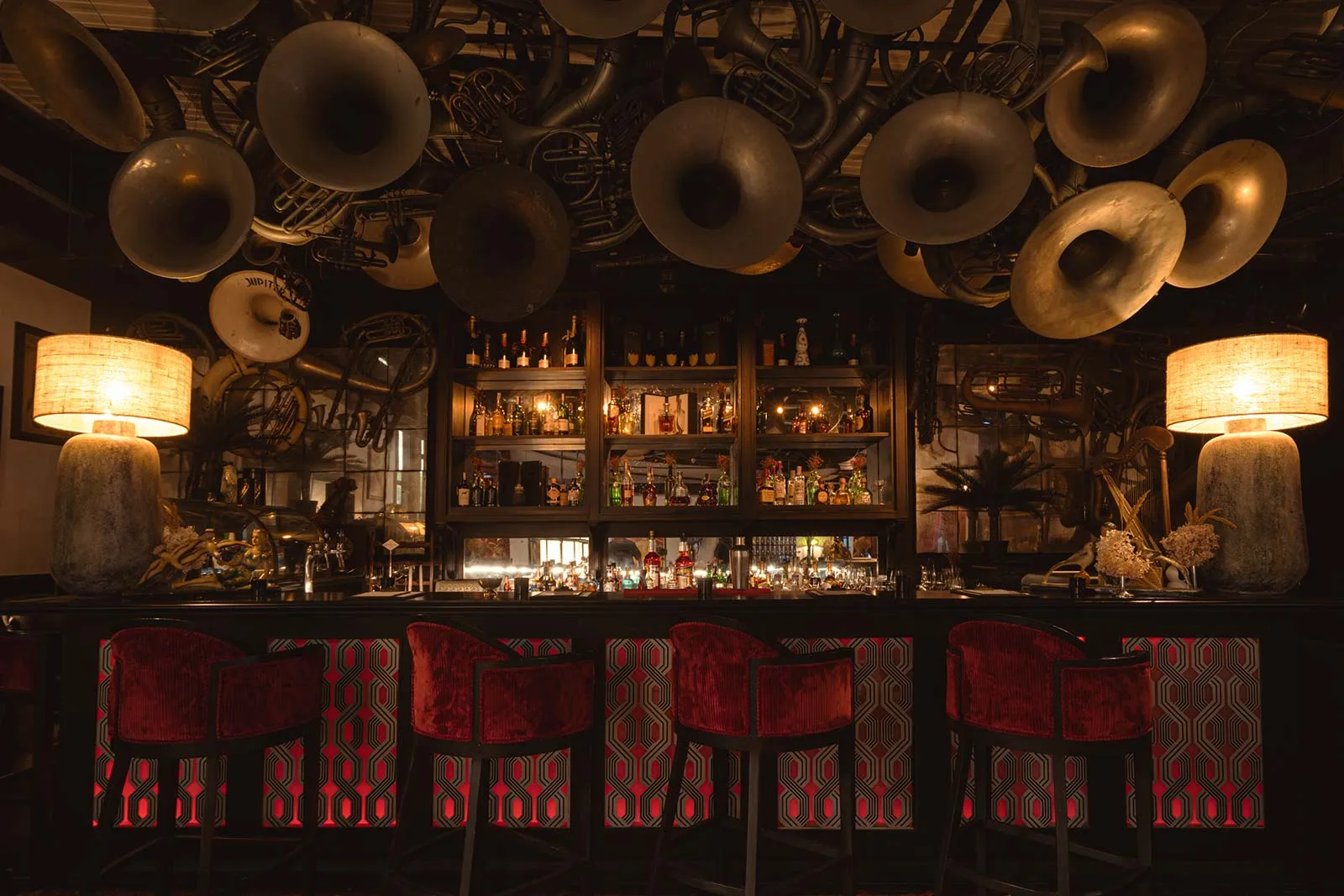
The Deco Bar is the room most senior-advisor placements turn on. Brass instruments mounted above the counter. Vintage cinema posters on the walls. An Art Deco theatricality that the Bamboo Bar’s straight lines, however excellent, cannot match. The bar reads to the right client as the Bangkok bar they have been looking for without knowing they were looking for it.
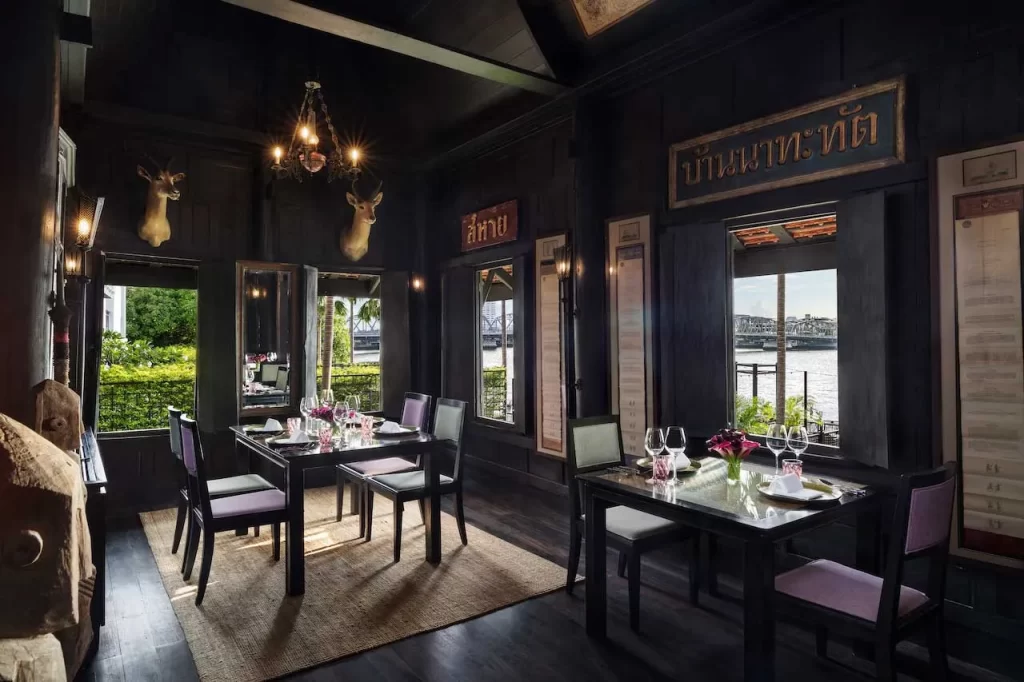
Chon — Thai for “spoon” — is the signature Thai restaurant. It is set in three century-old teakwood houses lifted from OSS agent Connie Mangksau’s former Bangkok compound. Connie’s guest list, during her lifetime, ran to Roger Moore, Jackie Kennedy, and Henry Ford. The houses were dismantled by Bensley’s team, transported, and rebuilt at The Siam — and the cooking inside them is some of the more considered Thai cuisine in the city, with a tasting-menu format that runs on private salas overlooking the river.
The Opium Spa is below ground level. The design references both Art Deco and traditional Turkish hammam. Five suites, each eighty square metres, each with private changing and treatment rooms. The spa can be cleared for private use — buyouts for groups, celebratory dinners, or full-evening hammam-and-bath programmes — by arrangement with the property.
The full property buys out for clients who want it. Thirty-nine keys at full lockout is, for the right brief, the most discreet Bangkok accommodation an advisor can deliver: a private estate on the river with the city at arm’s length.
The other named Bangkok placements
A short note on the rest of the field, in the order Discovery places them.
Capella Bangkok sits a kilometre further south on the Chao Phraya, opened in 2020 on the riverside near the Iconic Siam complex. It is the cleanest river-view-with-no-history option in the city — guests who do not want the weight of the Mandarin’s legacy, do not want the design-statement of The Siam, and do want a contemporary luxury-river hotel with full amenities, find their answer here.
Aman Nai Lert opened in 2025 as Aman’s first Bangkok property. The garden suites read closer to Aman Tokyo than to anything else in the city — high-ceilinged, garden-facing, designed around the embassy-quarter calm. The location is central, just off Wireless Road, near the embassies. The property is the right answer for the Aman-loyal client whose Bangkok brief asks specifically for the brand register.
The Sukhothai on Sathorn is the under-the-radar choice for guests who want the canon 1990s Bangkok hotel updated to 2026 working condition. The Celadon Thai restaurant remains one of the genuinely good Thai tables in the city; the property is quieter and less photographed than the river-side competitors. We place into the Sukhothai for clients who prize discretion above visibility.
The Peninsula sits across the river from the Mandarin and competes in roughly the same brief. The Peninsula’s tea programme and the spa are both world-class; the property suffers slightly from being on the opposite side of the river from the cultural and dining work most guests want to do, requiring boat or vehicle transfer for most activities outside the hotel.
The Bangkok we actually build
Discovery’s Bangkok product is a long way from a hotel choice.
The hotel is the bed. The work of a Bangkok stay is what happens between the bed and the next bed. Our standing Bangkok programme for the senior advisor’s client runs across four registers that the hotel pick does not address: the temple register (where, when, with whom), the food register (street, restaurant, market, kitchen), the cultural register (gallery, performance, design studio), and the river register (boat, klong, pier).
The Bangkok cluster — Bangkok Concierged — is where this material lives in full. The cluster covers our temple-pairing logic (which two of Wat Pho / Wat Suthat / Wat Paknam for a given client), the kitchen logic (which of Sorn / Le Du / Nusara / Potong for a given client; the Bangkok by Plate cluster develops this in dedicated form), the guide logic (Khun [guide name] for cultural-led, Khun [other name] for food-led), and the boat logic (private long-tail for the working river, the rice barge for the heritage river).
This spoke — The Mandarin Effect — is the bridge into that cluster. The hotel pick is the first decision the advisor makes. It is rarely the most consequential.
The trip Discovery would route
For the senior advisor’s Bangkok-shaped client, our default three-night Bangkok-only routing looks like this.
Night one: arrive late afternoon, check in at The Siam, evening at the Deco Bar, dinner at Chon. The night runs on the property — the welcome programme is the work.
Day two: morning at Wat Paknam (the show’s temple, which is in our view the more visually distinctive choice for first-day) with Khun [guide name], lunch in Chinatown at one of the smaller alternatives that is not booked four months out, afternoon at Bangkok CityCity or one of the Bangkok galleries, evening at one of the named-chef tables (Sorn for southern-Thai canon, Le Du for the modernist programme).
Day three: morning on the Chao Phraya by private long-tail, including a stop at Wat Suthat for the late-Ayutthaya register that the show did not film, lunch at one of the riverside Thai restaurants, afternoon at a kitchen visit or a Jim Thompson archive, evening at the Bamboo Bar at the Mandarin — because if the client has come to Bangkok via the show, the Bamboo Bar is worth the pilgrimage, and the pilgrimage works better as a single evening from another base than as the whole stay.
The pilgrimage is legitimate. The pilgrimage is also one evening, not three nights.
For the senior advisor’s client whose Bangkok brief extends to five nights or more, the additional days run on the Bangkok Concierged cluster — the cluster bridges directly from here.
For an active Bangkok brief — including buyout enquiries for The Siam, hammam-clearance for the Opium Spa, or full Bangkok Concierged programme briefs — send dates, party composition, and the primary interest register (temple / food / cultural / river / mixed) to the Thailand desk. We return a structured first pass within two working days.
This is the hub piece of Discovery’s White Lotus Thailand cluster. The full set of spokes:
- The Koh Kood Answer — how the Kiri Private Reserve airstrip on Koh Mai Si reshapes the access calculation
- Phuket After the Show: Villas, Chefs, and the Charter Fleet — the private-villa and superyacht map for the senior advisor’s brief
- The Mergui Crossing: Wa Ale and Awei Pila — the apex spoke, accessed from Ranong, no Myanmar overland required
- Koh Jum Villas: The Krabi-side Map — for the client who is done with the south
- The Mandarin Effect: Bangkok After the Bamboo Bar — bridges into our wider Bangkok Concierged cluster
- The Cultural Bookend: Temples and the River — what advisors should know about the show’s Bangkok cameos
- Mike White’s Thailand: The Trip the Show Should Have Taken
For a working brief, send dates and party composition to Discovery’s Thailand experts; we return a structured first pass within two working days.
Contact us: sales@discoverydmc.com
Explore Our Thailand Tours
DISCOVER MORE – The Mergui Crossing: Wa Ale, Awei Pila, and the Door Through Ranong
Comments are closed.